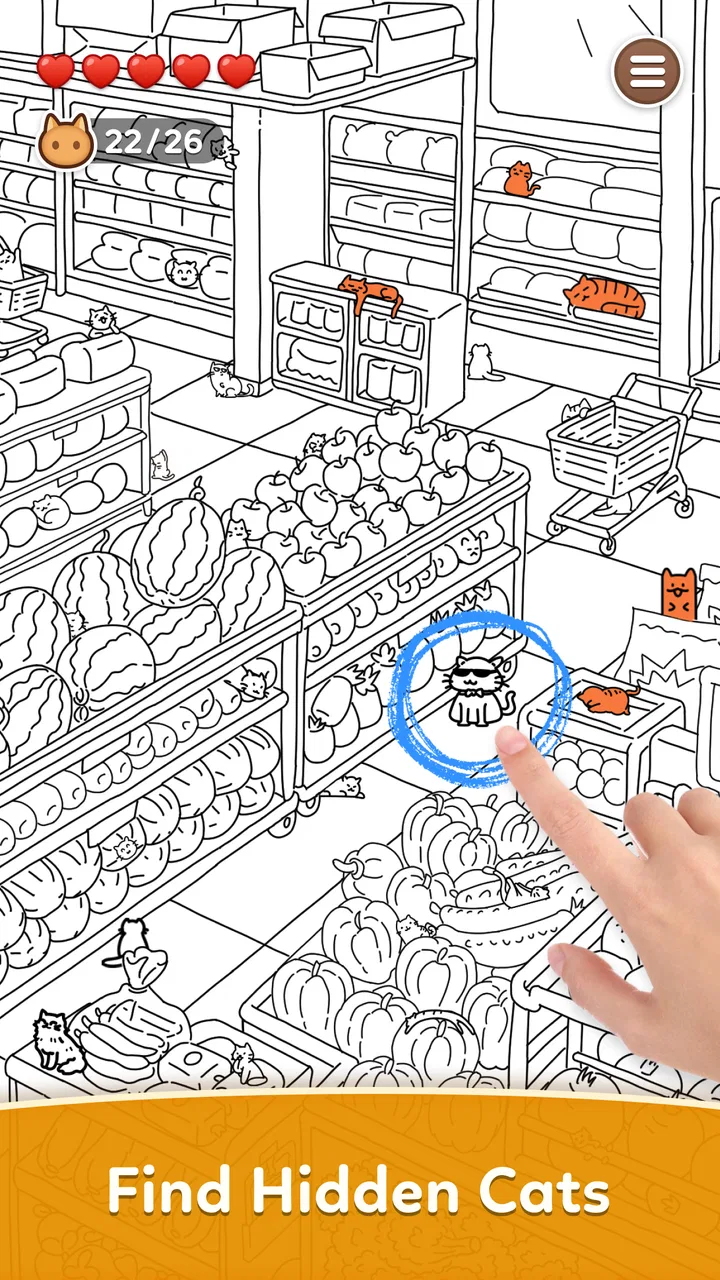
Find Hidden Cats- Spot it!
- 4.8
- Rating
- 1.00M
- Installs
- Free
- Price

 Analysis by App-foxy
I usually lose interest in casual games that ask me to repeat the same simple action without giving me a reason to look more carefully. Find Hidden Cats- Spot it! takes a more focused approach: the entire experience revolves around spotting cats hidden inside a scene. That sounds straightforward, but the effect is surprisingly different from a fast matching game or an endless puzzle. It encourages me to slow down, scan the whole picture, and trust my eyes rather than rush through a timer-driven challenge.
That central idea is also the game’s biggest strength. Instead of burying the player under complicated rules, the game gives one clear objective that works for short breaks, quiet evenings, or a relaxed activity with someone else. Playful Bytes presents it as a casual game for Everyone, and that description fits my experience. It is easy to understand immediately, free to play, and available for devices running Android 8.0 or later. The current version is 1.1.0, while the game has already passed over 500 thousand installs and holds a 4.9 average from around 3 thousand ratings.
Why the hidden-cat idea works so well
The important capability here is not simply recognizing a cat-shaped object. It is the way the game turns visual attention into the whole challenge. I am not managing an inventory, learning a character, or memorizing a long rule set. I am studying an image and trying to notice something that blends into its surroundings. That makes each moment feel calm at first, then gradually more demanding as obvious possibilities disappear.
You May Also Like

 Blood Strike: 2.5 Anniversary
Blood Strike’s Loadouts Turn Every Drop Into a Tactical Gamble
A close look at Blood Strike’s custom loadouts: how fast access to signature weapons reshapes its battle royale rhythm, rewards preparation, and narrows the gap between fights.

 Pandora - Music & Podcasts
Pandora’s Music Is Easy to Start, but Harder to Recover
Pandora’s strength is its low-effort path from a seed to a station. Its weak spot is how much confidence it asks you to place in connection, setup, and quiet recovery.

 8 Ball Pool
 Is Built on Rivalries, Rematches, and Routine
A close look at the rivalries, rematches, shared routines, and unanswered safety questions that turn a quick pool match into a persistent mobile community.

 Samsung Music
’s Quiet Strength Is Playing What You Already Own
Its reach comes less from spectacle than from dependable access to a personal library. That simplicity is both the app’s strongest retention engine and its ceiling.

 AccuWeather: Weather Radar
AccuWeather Review: A Quick, Clear Forecast for Everyday Decisions
For everyday plans, the best forecast is the one you can understand quickly. AccuWeather makes rain timing, radar, and local conditions easy to act on, with a few trade-offs.

 Hill Climb Racing
Why Hill Climb Racing Still Turns Crashes Into One More Run
A tiny car, a bumpy hill and one more upgrade: Hill Climb Racing keeps resurfacing because its simple chaos makes every near-miss feel personal.
More From Our News Desk
View All News


In practice, this creates a useful middle ground between a picture puzzle and a seek-and-find activity. The game’s short description, “Find Hidden Cats,” explains the goal, but the real appeal comes from the change in mindset it encourages. I start by looking at the center of the scene, then move toward corners, edges, repeated patterns, and areas where the colors seem slightly out of place. The search becomes less about tapping randomly and more about building a visual routine.
The best part is the shift from guessing to observing. A casual game can be relaxing without being empty, and this one works when I want something that occupies my attention without demanding a long commitment. It is especially suitable for players who enjoy hidden-object challenges but do not want an elaborate story, heavy controls, or a competitive format.
How I approach each scene
My first pass is broad. I look across the complete picture instead of locking onto one promising area. This prevents a common mistake in hidden-object games: spending too long investigating the first shape that resembles the target. If I do not spot anything, I divide the scene into sections and examine each one in a consistent order.
A second pass is more deliberate. I check silhouettes, unusual gaps, small changes in texture, and objects that seem slightly too symmetrical. Cats can be easy to miss when their outline shares the color or pattern of the background, so I find it more effective to search for interruptions in the scene rather than search only for a familiar face or body shape.
When I play with another person, I also avoid calling out every possibility immediately. We each scan a different part of the image first, then compare observations. That turns a solitary visual task into a simple cooperative activity without requiring extra rules. It is a good fit for a family setting because the objective is clear enough for a younger player while still giving adults a reason to stay engaged.
What makes the experience accessible
The game’s casual design is immediately approachable. I do not need to learn a complicated control scheme before beginning, and the subject matter is friendly rather than intense. The Everyone age rating reinforces that broad accessibility. Someone who rarely plays games can understand the purpose after a brief explanation, while a regular puzzle player can still appreciate the satisfaction of finding a well-blended cat.
Being free also lowers the barrier to trying it. That matters for this particular kind of game because the appeal is personal: some people love scanning illustrations, while others find that pace too quiet. I can test the experience without treating the download as a major commitment. The trade-off is that free casual games can feel less substantial than larger puzzle titles, so I would approach this as a focused visual pastime rather than a complete entertainment package.
Compatibility with Android 8.0 or newer makes it practical for many older phones and tablets. I would still recommend checking the device’s available storage and general performance before installing any game, especially on an older handset, but the stated minimum operating system is not unusually demanding. The main question is not whether the device is powerful enough; it is whether the player enjoys patient visual searching.
A realistic everyday use case
I can see myself opening this while waiting for an appointment, taking a short break between tasks, or sitting with a child who wants a game that does not involve fighting or complicated instructions. The hidden-cat format suits those moments because I can begin quickly and stop when my break ends. It does not require me to remember a story or rebuild a strategy after leaving it for a while.
It also works as a screen-sharing activity. If a friend or family member is nearby, we can look at the same scene and point out possible hiding places. That makes the game more social than its simple premise suggests. The strongest use is not a long solo session, but a handful of focused searches where the visual challenge remains pleasant instead of becoming tiring.
For a parent, the game may be a gentler alternative to faster casual titles. The player is practicing attention and visual discrimination in an informal way, although I would not treat it as a formal educational tool. For an adult, it can provide a small mental reset after a busy period. The game asks enough concentration to interrupt idle scrolling, but not so much that it becomes another demanding task.
How the core search feels in practice
The hidden-cat capability changes the rhythm of play. In a typical match-three or reflex game, I am often reacting to movement, limited time, or a constantly changing board. Here, the important action is looking. That slower rhythm is refreshing when I am tired, but it also means the game depends heavily on the quality and variety of its scenes. If a player prefers constant feedback or rapid decisions, this may feel too passive.
I find the search most satisfying when I resist the urge to tap every suspicious detail. Random tapping can make a picture feel noisy and reduces the satisfaction of finding the target through observation. A better approach is to use a repeatable scan: background first, then foreground, then borders and unusual clusters. This small habit makes the game feel more skill-based, even though the controls themselves are simple.
Another useful technique is to change distance from the screen. I sometimes notice an outline more clearly after looking away for a moment, while other times moving the phone slightly farther away helps reveal the overall shape. These are simple habits, but they matter because hidden-object puzzles often create visual fatigue when I stare at one area for too long.
Where it differs from familiar alternatives
Compared with match-three games, this is less about creating combinations and more about visual patience. There is no need to plan a chain of moves or react to a board that changes after every action. Compared with word puzzles, it does not depend on language, spelling, or general knowledge. Compared with fast arcade games, it offers a quieter experience with less pressure on reflexes.
Those differences make it a strong choice for players who want a low-pressure puzzle, but they also define its limits. Someone looking for progression systems, character development, competitive leaderboards, or a broad collection of unrelated mini-games may find the concept narrow. The focused design is appealing precisely because it does not try to become everything at once.
I would also choose a more traditional hidden-object game if I wanted a story-led adventure with detailed scenes and a long sequence of objectives. This game is better suited to the simple pleasure of spotting cats. The narrower premise makes it easier to pick up, but it may not provide the same sense of journey as a larger puzzle adventure.
Small habits that improve the search
My most useful tip is to divide the image into an invisible grid. I scan from left to right across the upper area, move downward, and repeat. This prevents my eyes from jumping randomly between interesting details. It is especially helpful when the scene contains many similar colors or repeated shapes.
I also look for negative space. A cat may be easier to identify by the shape of the empty area around it than by its internal details. Checking the boundary between objects, the space beneath larger shapes, and the outer edges of the scene often reveals possibilities that a center-focused scan misses.
Finally, I take a short visual reset rather than forcing the search. Closing my eyes briefly, looking at something in the distance, or rotating my attention to another part of the image can make a hidden outline stand out. This is a practical trade-off: persistence helps, but staring continuously at the same spot can make the scene harder to read.
Trade-offs that matter before installing
The game’s simplicity is both its attraction and its main limitation. Because the premise is so focused, the experience depends on whether I enjoy repeated visual searching. If I need a game that rewards rapid progress or constantly introduces new mechanics, I may lose interest sooner than I would with a more varied casual title.
The free price makes trying it easy, but free does not automatically mean ideal for every player. I would install it for relaxed discovery rather than expect a large, feature-heavy game. A person choosing it should be comfortable with a narrow central activity and judge the value by how enjoyable the act of spotting cats feels, not by the number of systems surrounding that activity.
Another consideration is attention load. The game is gentle in tone, but searching carefully can still become tiring during a long session. I get more from it when I play in short bursts and stop after my concentration starts to slip. That is not a flaw unique to this title; it is a natural consequence of asking the eyes to inspect detailed scenes repeatedly. Still, it is worth knowing if the goal is extended play.
The 4.9 average and over 500 thousand installs suggest that the concept has found a receptive audience, but popularity does not remove the need to match the game to personal taste. I would not recommend it to someone who dislikes hidden-object puzzles simply because the rating is high. The right audience is someone who enjoys noticing small visual differences and prefers a calm, clearly defined objective.
Who should skip it
I would skip this game if my priority were action, competition, narrative progression, or a deep puzzle system. It is also not the first choice for someone who finds visual clutter frustrating or who prefers games with a clear strategic layer. A match-three title may be more satisfying for players who like planning moves, while a word game may be better for anyone who wants a challenge based on vocabulary.
I would also be cautious about recommending it as a long-session game without knowing the player’s tolerance for repetition. The central activity is intentionally consistent. That consistency makes the game welcoming, but it can feel limited if I want every round to play differently.
Who gains the most from the focused design
The strongest audience is made up of casual players who want an immediate visual challenge with a friendly theme. It suits people who enjoy hidden-object books, picture puzzles, or quiet observation games. It is also a sensible choice for families looking for an easy activity that can be understood without a lengthy tutorial.
Adults who use games as short mental breaks may appreciate the lack of complicated setup. I can open it, focus on one scene, and put it down without losing the thread of a larger adventure. Players with newer phones may enjoy it, but the Android 8.0 minimum also keeps it relevant for people using older compatible devices.
Playful Bytes has kept the concept easy to explain, and that clarity is valuable. I can recommend it to a friend by describing the actual experience rather than listing a collection of unrelated features: look closely, find the cats, and enjoy the small satisfaction of noticing what was hidden in plain sight.
My final view after spending time with it
Find Hidden Cats- Spot it! succeeds because it understands the value of one well-defined idea. The game does not need complicated controls to hold my attention; it relies on the pleasure of careful looking. Its free access, Everyone rating, approachable casual format, and broad Android compatibility make it easy to try, while the high average rating shows that the simple premise has connected with many players.
I recommend it when I want a calm visual break, a family-friendly activity, or a puzzle that does not depend on words and fast reactions. I would choose something else for a deeper adventure, stronger variety, or competitive energy. The most honest way to describe this game is as a focused hidden-object experience: rewarding when I enjoy scanning scenes patiently, less convincing when I need constant novelty.
My advice is to play it with a method rather than rush. Scan in sections, inspect edges and negative space, and take a brief break when your eyes start to blur the details. Used that way, the game feels more satisfying and less like random tapping. For the right player, that modest loop is enough to make a few spare minutes feel pleasantly occupied.
FAQs for Find Hidden Cats- Spot it!
01What is the main objective of Find Hidden Cats- Spot it!?
The main objective of Find Hidden Cats- Spot it! is to challenge players to locate hidden cats within various intricate and beautifully designed scenes. Each level presents a unique environment filled with clever hiding spots, requiring keen observation skills and attention to detail to spot all the elusive felines.
02Is Find Hidden Cats- Spot it! suitable for all ages?
Yes, Find Hidden Cats- Spot it! is designed to be suitable for players of all ages. The game features intuitive touch controls and visually appealing graphics that cater to both young players and adults. It’s a delightful way for families to enjoy some quality time together while honing their observational skills.
03Does Find Hidden Cats- Spot it! require an internet connection?
Find Hidden Cats- Spot it! does not require a constant internet connection to play. Players can enjoy the game offline, which makes it perfect for playing on-the-go or during travel. However, some features, such as in-app purchases or updates, may require internet access.
04Are there in-app purchases in Find Hidden Cats- Spot it!?
Yes, Find Hidden Cats- Spot it! offers in-app purchases. While the game is free to download and play, there are optional purchases available that can enhance the gaming experience. These may include hints, additional levels, or aesthetic upgrades. Purchases are entirely optional and not necessary to enjoy the game.
05What devices is Find Hidden Cats- Spot it! compatible with?
Find Hidden Cats- Spot it! is compatible with both Android and iOS devices. It requires Android 5.0 or later and iOS 10.0 or later to run smoothly. The game is optimized for a variety of screen sizes, ensuring a seamless experience whether on a smartphone or tablet.
Pros
- Engaging puzzles keep players entertained.
- Visually appealing graphics and design.
- Regular updates with new levels.
- Suitable for all age groups.
- Easy to learn and play.
Cons
- Ads can be intrusive during gameplay.
- Limited hints available without purchase.
- Some levels may be too challenging.
- Occasional glitches on older devices.
- In-app purchases can be pricey.

Find Hidden Cats- Spot it!
Gallery